
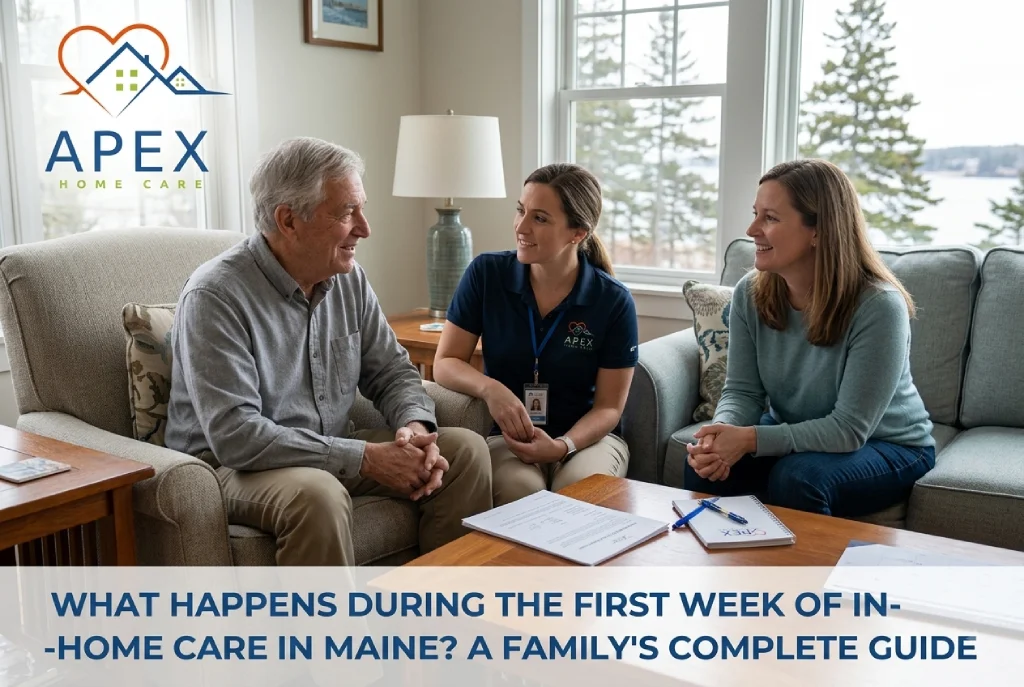

What happens when in-home care starts in Maine? During the first week of in-home care in Maine, a family typically goes through four stages: a free consultation, a personalized care plan meeting, the first caregiver visit, and settling into a routine. This is what senior care at home actually looks like in its first seven days — most families report that anxiety turns to relief within the first two visits.
Here’s exactly what each stage looks like — and what to expect at every step.
Introduction: What Maine Families Are Really Bracing For
The first week of in-home care in Maine is rarely what families picture in their heads beforehand. After weeks — sometimes months — of watching a parent struggle with things that used to be simple, a family finally makes the call and arranges in-home senior care. Then a different kind of worry sets in. Will Mom accept a stranger helping her get dressed? Will Dad feel like he’s lost his independence the moment someone walks through the door? Will this actually work, or will it just feel forced and awkward for everyone involved? These questions are completely normal — and almost every family who has been through it will tell you the same thing: the fear beforehand is always bigger than the reality.
“The families I work with are almost always surprised,” says one Apex caregiver who has served households across Cumberland County for years. “Not by how hard the first week is, but by how quickly it stops feeling strange. By the end of day two, most seniors are already asking what time their caregiver is coming back tomorrow.” That shift — from hesitation to genuine anticipation — is what a well-run first week of home care for seniors looks like in practice. It isn’t about forcing a routine onto someone. It’s about building trust one visit at a time, inside a home that already feels safe.
Why the First Week of In-Home Care Feels Harder for Families Than for Seniors
Here’s something counterintuitive that comes up in almost every consultation: families are usually more anxious than the senior receiving care. Guilt, fear of judgment, and worry about whether the caregiver will “get” their parent all build up in the days before that first visit. During the first week of in-home care in Maine, though, families often find that the senior adapts faster than anyone expected, especially when the caregiver is calm, consistent, and doesn’t rush anything.
The fears families bring to that first call are almost always some version of the same three: “Will my parent feel replaced?” “Will they be embarrassed in front of a stranger?” and “What if this person doesn’t understand who my parent really is?” Those are fair questions, and a good home senior care provider addresses them head-on rather than brushing past them.
There’s also a Maine-specific pattern worth naming: seniors who have spent a long winter mostly isolated — fewer visitors, shorter days, icy sidewalks keeping them indoors — often respond quickly to consistent human presence. The first visit fills a gap in their week that families didn’t always realize had grown that large. Personal home care isn’t just about tasks; it’s often the first regular social contact a senior has had in months.
What if my parent seems uncomfortable at first?
Discomfort during the first visit or two is normal, not a warning sign. Most seniors need two to three visits before real comfort sets in, and a good caregiver expects that. During the First Week of In-Home Care in Maine, the approach stays low-key: following the senior’s lead rather than rushing into a task list. Apex’s home care service keeps things simple — the same caregiver comes every time. Familiarity builds faster with consistency than with variety, and by visit three, most of that early stiffness has already faded.
Before Day One: What Happens During the Free Consultation?

Before any caregiver ever sets foot in the home, there’s a conversation. The free consultation is where a Maine family and an in-home care coordinator sit down — by phone, video, or in person — and talk through what’s actually going on. This usually takes 30 to 45 minutes and covers the senior’s daily routine, a general overview of their medical history, personality and preferences, how the family wants to receive updates, and rough budget and scheduling needs.
What families get out of this call is clarity, not a sales pitch. A trustworthy home care agency gives an honest recommendation of what level of care actually fits, sometimes that’s daily support, and sometimes it’s two mornings a week. For families considering the First Week of In-Home Care in Maine, in-home assistance may begin with a simple, flexible schedule that matches the senior’s needs. Nobody is pressured to sign anything on the spot. Most families take a day or two afterward to think it over, and that’s expected.
What information should I have ready before the consultation?
- Current medications and any known allergies
- A rough outline of a typical day for your loved one
- Specific challenges — mobility, meals, driving, medication management
- Preferred days and times for visits
- Insurance or long-term care policy details, if applicable
You don’t need to have it all figured out before you call—that’s what the consultation is for. Families in Scarborough, Windham, and across Cumberland County often arrive at their first call with more questions than answers, and that’s exactly the point of having one.
Day One to Three: Building the Personalized Care Plan
Once a family decides to move forward, the next one to two days go into building the care plan. This isn’t a rigid document that gets filed away — it’s a living schedule built specifically around the senior’s preferences, routine, and needs. A good care plan spells out the visit schedule, the specific tasks for each visit, which caregiver is matched to the family, how updates will be communicated, emergency contacts, and how medication reminders will be handled.
Customization matters more here than almost anywhere else in the process. No two Apex care plans look identical, because no two seniors need the same thing. A Scarborough senior who mainly wants help with morning routines and grocery runs needs a very different plan than a Falmouth senior whose biggest need is companionship and transportation to appointments. This is where senior care services and personal care services get tailored to the household, not the other way around.
Can the care plan change after the first week?
Yes — and it should. The first week is always a calibration period, not a final answer. Schedule adjustments, added tasks, and timing changes are a completely normal part of getting the plan right, not a sign that anything went wrong. Apex reviews the care plan with the family after week one as standard practice, so nothing has to stay set in stone if it’s not working.
The First Visit: What Actually Happens Hour by Hour
This is the part most families really want to know about. Here’s what a real first visit looks like, in a typical Maine home.
The caregiver arrives on time — Apex treats punctuality as non-negotiable, since being even a few minutes late can shake a senior’s early trust. They introduce themselves by first name, not a title, and they don’t wear a uniform. That small detail matters more than it sounds; a caregiver in street clothes reads as a visitor, not a clinical presence, and that softens the whole tone of the visit. If it’s a winter appointment, the caregiver helps with coat and boots on the way in, checks that the walkway is clear and safe, and brings a bit of warmth into the interaction before a single task is discussed.
The first 20 to 30 minutes are intentionally low-key and senior-led — conversation, maybe a cup of tea, letting the senior set the pace rather than walking in with a checklist. From there, the visit eases into a shared task: tidying a kitchen counter together, folding laundry while chatting, or a short walk if the weather and the senior’s mobility allow it. The goal of visit one isn’t productivity. It’s for the senior to end the hour thinking “that wasn’t bad,” not “that was a lot.” Before leaving, the caregiver does a brief wrap-up, and shortly after, the family receives their first update.
What does the caregiver actually do during the first visit?
The first visit is intentionally lighter than later ones — relationship-building comes before task-heavy support. Expect conversation, light help with something familiar like making tea or tidying a room, a short walk if it fits, and a caregiver who listens more than they direct. Heavier personal care tasks usually wait until the senior is visibly more at ease, often by the second or third visit.
Will my parent be left alone with a stranger?
Not if the family doesn’t want that. A family member is welcome to be present for the first visit, and many are — especially when the senior has memory concerns. Apex actively encourages family presence early on if it helps the senior feel more secure. It’s also worth knowing that every caregiver has passed a background check and completed training specific to in-home elder care before ever being matched with a family, so “stranger” is a fair first instinct but not an accurate one by the time the visit happens.
| Time | What the Caregiver Does | What the Senior Experiences |
|---|---|---|
| Arrival (0 min) | Arrives on time, introduces themselves by first name | Meets a friendly, unhurried presence at the door |
| Introduction (5 min) | Casual conversation, no uniform, no clipboard | Realizes this doesn’t feel clinical |
| First conversation (15 min) | Follows the senior’s lead, asks about their day | Starts to relax and open up |
| First task together (30 min) | Light shared activity — tea, tidying, a short walk | Feels like company, not supervision |
| Mid-visit check (45 min) | Gentle check-in on comfort and needs | Feels seen without being pressed |
| Wrap-up (55 min) | Confirms next visit, says goodbye warmly | Already asking when the caregiver returns |
| Family update (after visit) | Sends a summary via text, call, or email | N/A — family gets peace of mind |
Days Two to Five: When the Routine Starts to Click
The second visit is usually noticeably easier than the first. The senior is more relaxed, the caregiver has already learned a bit of their rhythm, and tasks that felt like an imposition on day one start happening more naturally. By day three or four of the first week of in-home care in Maine, most seniors begin anticipating the visit outright—asking what time the caregiver is coming or having something specific they want to talk about or show them. This is often when in-home senior care starts to feel like a natural part of the senior’s routine.
Families usually notice a few consistent signs that things are going well: their parent mentions the caregiver by name unprompted, seems brighter or more talkative after visits, is eating more regularly, and generally seems to be settling back into a routine that had slipped. If something feels off instead the caregiver and senior just don’t click, or a task isn’t getting done—the right move is to say so directly. Care plan adjustments and caregiver rematches are always available, though in practice they’re not common once the first visit or two go reasonably well.
How does Apex keep family members updated during the first week?
After every visit, the caregiver logs notes on what happened, how the senior seemed, and anything worth flagging. The family chooses how they want to hear it — text, phone call, or email — and that preference gets set during the care plan meeting, not guessed at afterward. For families who live out of state or simply can’t be there in person, this update is often described as the single biggest relief of the first week of in-home care in Maine. It replaces “I hope everything is okay” with an actual answer.
End of Week One: What a Successful Start Looks Like

It helps to have a clear, honest picture of what “success” actually means after week one — because it isn’t perfection, it’s establishment. A first week has gone well if the senior accepted the caregiver without major resistance, at least one task got completed with help, the family received at least one meaningful update, and the senior has positively mentioned the caregiver, even in passing.
There are also signs worth watching for that simply mean a course correction is needed — not that at-home care isn’t working. These include a senior who’s still quite resistant after three visits, a caregiver and senior whose personalities or timing just don’t mesh, or tasks that aren’t getting done consistently. All of these are fixable, and all of them are a normal, expected part of getting a new arrangement right. During the first week of in-home care in Maine, noticing these issues early can make it easier to adjust the care plan and create a better fit.
What Happens After the First Week — Does the Care Plan Get Reviewed?
Yes — this is standard practice at Apex. A short review call with the family happens after the first week of in-home care in Maine to adjust the schedule, tasks, or timing based on how those first few visits actually went. Care also tends to evolve naturally from there: what starts as two mornings a week often grows as the relationship between senior and caregiver strengthens and trust builds. And if the family caregiver themselves needs a break at any point, respite care is available too — this first week isn’t just about the senior adjusting; it’s about the whole family finding a sustainable rhythm.
How Apex Home Care Starts In-Home Care in Maine
Apex Home Care is based in Westbrook and serves families throughout Cumberland County and beyond. The process families go through follows three clear steps: a free consultation, a personalized care plan, and the first caregiver visit. Most families move from that first phone call to their first visit in three to five days — faster when the situation is urgent, such as a recent hospital discharge that needs post-hospital care right away. This helps make the first week of in-home care in Maine feel more organized, predictable, and manageable for families.
Consistency is a real commitment, not a marketing line — the same caregiver comes at the same time, building an actual relationship instead of a rotation of unfamiliar faces. Whether a family needs companion care, personal care, broader senior care services, or post-hospital support, the same first-week process applies: a free consultation, a plan built around the person — not a template — and a caregiver who shows up reliably. Families ready to talk through their situation can reach Apex at 207-329-1626.
Frequently Asked Questions: Starting In-Home Care in Maine
How quickly can in-home care start in Maine after the first call?
What if my parent refuses the caregiver during the first visit?
Do I have to be present for the first visit?
How many hours per week does home care start with?
What does the caregiver do if something goes wrong during a visit?
Will the same caregiver come every visit?
Does Medicare or MaineCare cover the first week of in-home care?
How do I get updates about what happened during my parent’s care visits?
The First Step Is a Phone Call — Everything Else Follows
The first week of in-home care in Maine is rarely as hard as families fear going in; for most, it’s mostly relief. The line families say more than any other, once they’re a few weeks in, is simple: “I wish we had done this sooner.” That’s not a sales line. It’s just what tends to be true once the anxiety of “what if” gets replaced by an actual routine.
The first conversation with Apex is free, takes about 20 minutes, and commits your family to nothing — it simply gives you a clear picture of what care could look like. Apex serves families in Scarborough, Westbrook, Portland, Falmouth, South Portland, Windham, Gorham, and across Cumberland County.
Ready to Start In-Home Care in Maine?
Apex Home Care serves families across Cumberland and York Counties. Let’s talk through what the first week could look like for your family — no pressure, no obligation.