
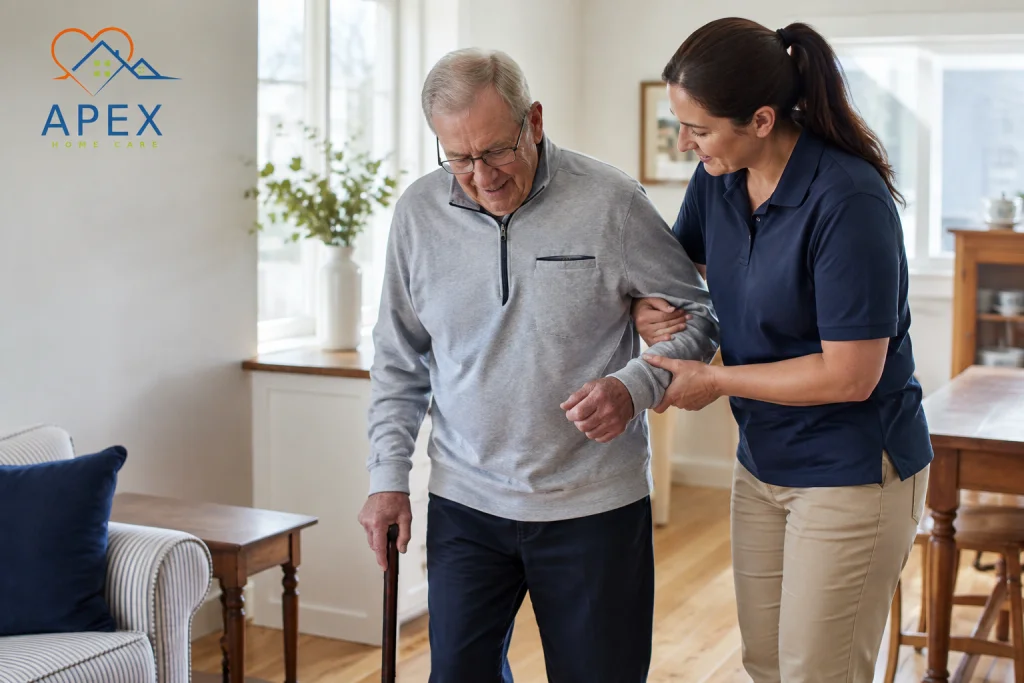

Parkinson’s care at home in Maine is non-medical, in-home support that helps someone with Parkinson’s disease manage daily life safely — personal care, mobility assistance, meal preparation, medication reminders, and companionship — while their neurologist and care team continue to manage the disease itself.
It’s not a replacement for medical treatment. It’s the steady, hands-on help that fills the gap between doctor visits, so families across York, Cumberland, and Androscoggin County can worry less about falls, missed pills, and burnout. Talk to Apex Home Care about a plan built around your loved one’s stage of Parkinson’s.
Table of Contents
Why Parkinson’s Makes Staying Home Both Harder and More Important
If you’re reading this after a hard day, we want to say something first: what you’re feeling is normal. Parkinson’s doesn’t move in a straight line, and neither does your worry. Some weeks your mom seems almost like herself. Other weeks a simple trip to the bathroom turns into an ordeal, and you start wondering if home is still the safest place for her.
Here’s the tension nearly every family we meet describes: your loved one wants, understandably, to stay in the house they know. You want that too. But the disease keeps changing the rules—a new tremor, a slower walk, a fall that “was nothing” but shook everyone up. In-home care for Parkinson’s disease exists for this in-between space, where a person is too capable for a facility but needs more support than family alone can safely provide every day.
This guide covers what non-medical Parkinson’s care at home in Maine looks like, the warning signs it’s time for help, and practical ways to make a Maine home safer—whether you’re in Portland, Scarborough, or a smaller town like Gorham.
What Does Parkinson’s Actually Change About a Person’s Day?
In plain terms: Parkinson’s slows movement, makes muscles stiffer, and adds unpredictable tremors—which turns ordinary tasks like buttoning a shirt, standing up from the couch, or carrying a cup of coffee into small daily risks. It also brings fatigue that doesn’t match how much someone actually did that day.
We won’t walk through clinical staging here—that’s your neurologist’s job. What matters day to day is more concrete:
- Tremors that make holding a fork, writing a check, or buttoning a coat unpredictable from one hour to the next
- Slower, stiffer movement that turns a two-minute walk to the mailbox into a ten-minute effort
- “Freezing” episodes, where the feet seem to stick to the floor mid-step, often at doorways or turns
- Fatigue and low energy that hits harder in the afternoon, even after a full night’s sleep
- Softer, quieter speech that makes phone calls and even ordering at a restaurant more tiring
- Balance changes that increase the real, practical risk of a fall on stairs or in the bathroom
None of this means someone with Parkinson’s has “lost” their independence. It means the day now has more friction in it than it used to, and a second set of steady hands makes that friction a lot less exhausting for everyone involved.
What Does Non-Medical Home Care for Parkinson’s Actually Include?
Short answer: a trained, non-medical caregiver helps with the physical and practical side of the day—moving safely, eating well, staying on schedule, and not feeling isolated. Think of it as the difference between managing the disease and managing the day.
Mobility Assistance
Steady help standing, walking, and transferring safely between bed, chair, and bathroom.
Personal Care
Bathing, dressing, and grooming support for hands that don’t always cooperate.
Meal Preparation
Meals prepared for someone who tires easily, plus encouragement to eat and stay hydrated.
Medication Reminders
Gentle, on-time reminders — caregivers remind and support; they do not administer or adjust doses.
Companionship
Conversation, patience, and a familiar face that reduces the isolation Parkinson’s often brings.
Light Housekeeping
Keeping walkways clear, laundry done, and the home tidy enough to reduce everyday trip hazards.
Where Non-Medical Home Care for Movement Disorders Stops
We say this clearly because it matters: Apex Home Care is a non-medical home care provider. Our caregivers support someone living with Parkinson’s, but they don’t administer medications, perform physical therapy, or make treatment decisions. That stays with the neurologist, primary care physician, and any home health nurse already involved.
Done well, non-medical care and medical care work as a team. A caregiver who spends hours a day with your loved one often notices small changes—a new stumble, less appetite—before anyone else does and can flag it for the family to raise with the doctor.
What Are the Signs It’s Time for Home Care for a Parkinson’s Patient?
The short version: if falls are becoming more frequent, if the family caregiver is running on empty, or if medication timing keeps slipping, it’s time to bring in support—before the next crisis, not after it.

Most Maine families didn’t plan to wait this long. It happens gradually, and by the time someone reaches out, they’ve often been managing quietly for months. Here’s what we’d flag as a genuine turning point:
- Rising fall risk—a near-fall, a stumble caught just in time, or an actual fall in the last few months, especially near stairs, rugs, or the bathroom
- Missed or mistimed medication—Parkinson’s medication is famously sensitive to timing, and a dose taken an hour late can visibly worsen symptoms for the rest of the day
- Caregiver exhaustion—a spouse or adult child who’s stopped sleeping through the night, canceled plans repeatedly, or feels resentful and then guilty about it
- Weight loss or skipped meals—often because eating has simply become tiring or slow, not because appetite is gone
- Withdrawal from friends and routines—declining invitations that used to be easy yeses
- A “close call” that scared everyone—a stove left on, a wrong turn on a familiar drive, a fall alone at home with no one to call
If two or three of these sound familiar, that’s not a sign you’ve failed as a family. It’s a sign the disease has moved into a new phase, and the support around your loved one needs to move with it.
How Do You Make a Home Safer for Someone With Parkinson’s?
In short: most Parkinson’s home safety improvements are inexpensive and room-specific—better lighting, cleared pathways, grab bars, and a predictable routine that reduces the “rushing” that often triggers a freeze or a stumble.
Fall prevention for Parkinson’s is less about one big renovation and more about small, deliberate changes. Here’s how we typically walk through a home during a safety assessment:
| Area of the Home | Practical Change | Why It Matters for Parkinson’s |
|---|---|---|
| Bathroom | Grab bars by the toilet and in the shower, a raised toilet seat, a non-slip mat | Standing and transferring are the highest-risk moments of the day |
| Hallways & Doorways | Clear, wide paths; remove throw rugs; add contrasting tape at thresholds | Doorway transitions are a common trigger for “freezing” episodes |
| Bedroom | Bed rail or sturdy furniture within reach, nightlight, phone within arm’s reach | Nighttime trips to the bathroom carry outsized fall risk |
| Stairs | Handrails on both sides, brighter lighting, non-slip stair treads | Stiffness and slower reflexes make stairs riskier over time |
| Kitchen | Frequently used items moved to waist-height, a stable chair for seated tasks | Reduces reaching and standing fatigue during meal prep |
| Daily Routine | Consistent meal and medication times, less rushing between tasks | Predictability lowers stress, which can visibly ease tremor and stiffness |
The routine piece surprises a lot of families. In our experience, a consistent daily rhythm—same wake time, same medication schedule, unhurried meals—does almost as much for safety as the physical modifications. Symptoms often flare under rushed, stressful conditions, and a calm routine takes some of that pressure off.
For general falls guidance beyond Parkinson’s-specific changes, the CDC’s STEADI fall-prevention initiative is a solid, practical starting reference many home health teams already use.
What Does Parkinson’s Care at Home Cost in Maine, and Does Insurance Help?
Short answer: non-medical Parkinson’s care at home in Maine is typically private pay, billed hourly, with cost depending on how many hours of support your loved one needs each week. MaineCare and VA benefits can offset some of that cost for eligible families—Medicare generally does not cover non-medical care.
- Private pay: the most common way families fund non-medical Parkinson’s home care, billed by the hour with flexible scheduling
- MaineCare (Maine’s Medicaid program): may cover some non-medical home care services for eligible seniors—eligibility depends on income and care needs, so it’s worth checking directly
- VA Aid & Attendance benefit: veterans and surviving spouses may qualify for a pension add-on that helps cover in-home caregiving costs
- Medicare: covers skilled home health care ordered by a doctor but generally does not cover non-medical personal care or companionship
We’d rather be upfront about this than vague: costs vary by hours needed and by county, and the only accurate number is one built around your loved one’s actual care plan. A free consultation gets you a real, no-obligation estimate—not a generic rate card.
If You’re the One Running on Empty
We’d be doing you a disservice if we didn’t say this plainly: caring for someone with Parkinson’s is physically and emotionally demanding, and the person most likely to burn out is you. That deserves its own real conversation, not a quick paragraph tucked at the end of a safety checklist.
We’ve written a dedicated guide on recognizing burnout and using respite care to protect your own health while caring for a loved one—read Family Caregiver Support in Maine for that fuller conversation, or explore respite care services directly if you need a planned break now.
Why Maine Families Choose Apex for Parkinson’s Care at Home
We built our approach around one idea: a caregiver for a Parkinson’s patient needs to understand the disease’s rhythm, not just follow a generic checklist—why rushing triggers a freeze, why a late dose changes the whole afternoon, and why bathroom fall risk looks different than stair fall risk. Our caregivers complete Parkinson’s-specific training beyond standard home care certification, and Apex is licensed with the State of Maine—ask to see it, or check the Maine DHHS registry directly.
Every care plan starts with a real conversation with your family and, where possible, your loved one’s care team. From there, we combine personal care, companion care, and mobility support into a schedule that fits your household, from a few mornings a week to full daily coverage. Browse our full senior care services or our care resource blog for more Maine-specific guides.
Apex Home Care serves families across York, Cumberland, and Androscoggin Counties, including Falmouth, Westbrook, and South Portland. Weighing home care against a facility? Our home care vs. assisted living in Maine guide can help. If a recent hospital stay is part of the picture, our post-hospital care at-home service can bridge that recovery safely.
For broader context on the disease itself, the Parkinson’s Foundation and the National Institute on Aging are two reliable, medically grounded resources worth bookmarking alongside this guide.
Learn more about Apex’s approach: About Apex Home Care | Our Services
Frequently Asked Questions: Parkinson’s Care at Home in Maine
What does Parkinson’s care at home in Maine actually include?
How much does Parkinson’s care at home cost in Maine, and does insurance help?
Is Apex Home Care licensed to provide Parkinson’s care at home in Maine?
Is home care for Parkinson’s patients different from regular senior care?
Can a non-medical caregiver give Parkinson’s medication?
What are the warning signs it’s time for home care with Parkinson’s?
How can I make my home safer for someone with a movement disorder like Parkinson’s?
Where does Apex Home Care provide Parkinson’s support in Maine?
What if I’m the family caregiver and I’m burning out?
How do I start home care for a parent with Parkinson’s in Maine?
Ready to Talk Through Parkinson’s Care at Home in Maine?
Parkinson’s care at home in Maine looks different for every family. Apex Home Care serves York, Cumberland, and Androscoggin Counties — let’s build a care plan around your loved one’s stage of Parkinson’s, and give you room to breathe.