
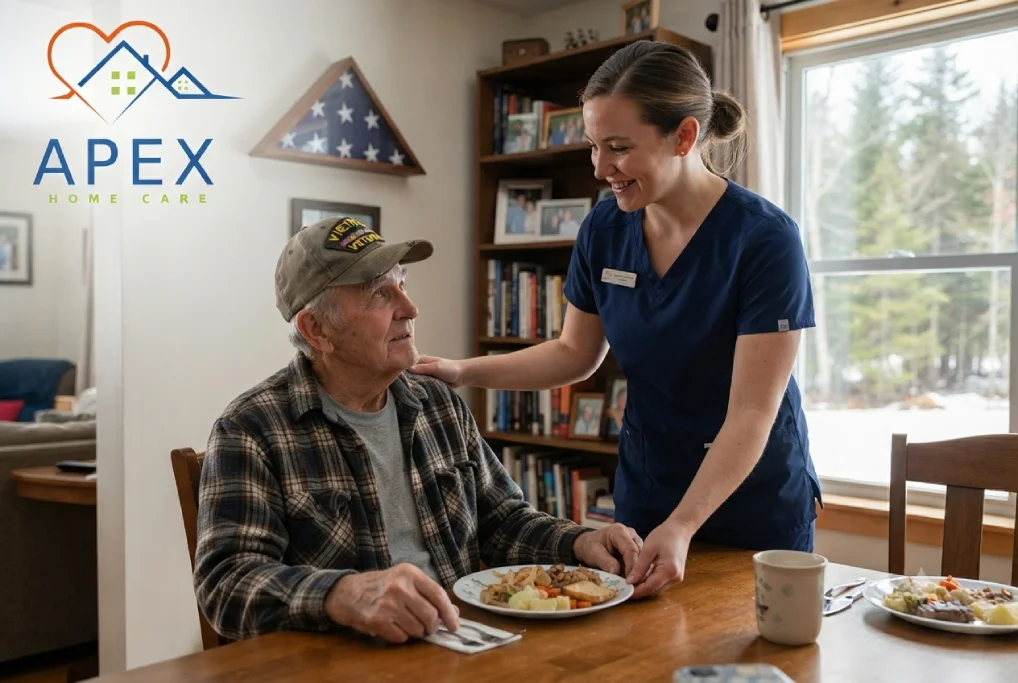

VA Aid & Attendance is a tax-free monthly pension add-on for wartime veterans and surviving spouses who need help with daily tasks like bathing, dressing, or meal preparation. As of 2026, it can pay up to roughly $2,874 a month for a veteran with a spouse, up to $2,424 a month for a single veteran, and up to $1,558 a month for a surviving spouse.
The money can be used to pay for home care directly. Maine veterans apply through the Maine Bureau of Veterans’ Services or the VA, and Apex Home Care can help coordinate care once the benefit is approved.
Table of Contents
A Benefit Maine Veterans Earned but Rarely Claim
If you or a parent served during a wartime period, there’s a good chance you’re sitting on a benefit you don’t know exists. VA Aid & Attendance is not a new program—it’s been on the books for decades—yet in our conversations with Maine veteran families, we consistently meet people who’ve never heard a Veteran Service Officer mention it or who assumed “VA benefits” only meant disability compensation.
That gap matters. Families in Portland, Lewiston, and Auburn are often paying privately for home care while a monthly, tax-free check they’ve already earned sits unclaimed. This guide walks through, in plain language, what the benefit is, who qualifies, how much it pays, and exactly how to apply in Maine.
We’ll also be direct about the genuinely confusing parts—the income test, the medical-expense deduction, and the paperwork—because glossing over those details is exactly what leaves eligible veterans stuck.
What Is VA Aid & Attendance, in Plain Language?
VA Aid & Attendance (A&A) is an increased monthly payment added on top of the basic VA pension. It’s not a separate application in most cases—it’s a box you check on the standard pension form, indicating that you need regular help from another person for daily activities or that you’re largely confined to your home.
Unlike VA disability compensation, A&A doesn’t require a service-connected injury. It’s needs-based—built around your income, assets, and level of daily-living need, not what happened to you in uniform. That distinction confuses a lot of families, because “VA benefits” so often get equated with combat-related disability.
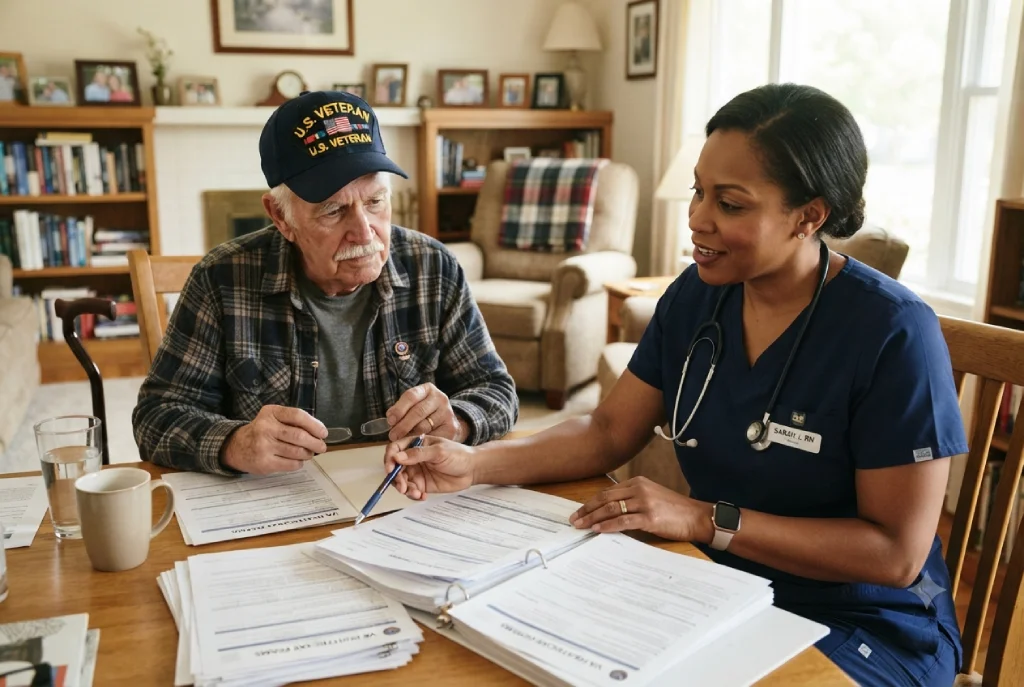
The money is paid directly to the veteran or surviving spouse—not to a facility or agency—and can legally be used to pay a family member who’s providing care, not only a licensed agency. That flexibility is one of the least understood parts of this benefit.
Who Qualifies for Veteran Home Care Benefits Through Aid & Attendance?
Eligibility rests on three separate tests, and a veteran or surviving spouse must clear all three. Miss one, and the application stalls—which is why so many Maine families lean on a Veteran Service Officer rather than filing solo.
Wartime Service
At least 90 days of active duty, with 1+ day during a recognized wartime period (WWII, Korea, Vietnam, or the Gulf War era onward). Discharge must not be dishonorable.
Age or Disability
The veteran is 65 or older, or is permanently and totally disabled (no age minimum applies to a surviving spouse).
Daily-Living Need
Regular help is needed with at least one activity of daily living — bathing, dressing, toileting, eating — or the person is substantially confined due to illness.
Income & Net Worth
Countable income must fall under the Maximum Annual Pension Rate (MAPR), and net worth must be under the VA’s published limit for the benefit year.
The Income Test Isn’t as Rigid as It Sounds
Here’s the part most families miss: unreimbursed medical expenses—including the cost of in-home care—are subtracted from countable income before the VA compares it to the pension limit. A veteran whose pension income looks too high on paper can still qualify for VA Aid & Attendance once ongoing caregiver costs are factored in.
A quick worked example: a surviving spouse with $28,000 in annual income and $2,000 a month in home care costs has roughly $24,000 a year in deductible medical expenses. Subtracted from income, that leaves close to $4,000 in countable income — well under the surviving-spouse MAPR ceiling, which can unlock most or all of the available monthly benefit.
Apply for A&A at the same time you start arranging personal care—the paid care hours often become the documentation that pushes the application through.
Does the VA Pay for a Caregiver for My Parent?
Short answer: yes, indirectly. The VA doesn’t hire or pay a caregiver directly—instead, Aid & Attendance pays the veteran or surviving spouse, who then uses those funds toward home care, whether that’s a licensed agency or a documented family caregiver arrangement.
This is the piece that trips up a lot of adult children searching for help online—they’re looking for “does the VA pay for a caregiver” and don’t realize the benefit and the eligibility rules above are the answer.
Surviving Spouse Benefits Have Their Own Rules
A surviving spouse may qualify for VA Aid & Attendance through the Survivors Pension if they were married to the veteran for at least one year before death (or had a child together) and have not remarried before age 57. There’s no minimum age requirement, which surprises many widows and widowers who assume the benefit is only for older veterans themselves.
What Can Veteran Home Care Benefits Actually Pay For?
A&A funds are paid to the veteran or surviving spouse with no restrictions on how they’re spent within long-term care—unlike Medicaid, there’s no requirement to use a specific licensed provider network.
| Care Setting | Can A&A Be Used? | Notes for Maine Families |
|---|---|---|
| In-home personal & companion care | Yes | Most common use — pays a home care agency or a family caregiver directly |
| Assisted living | Yes | Counted as an unreimbursed medical expense against income |
| Skilled nursing facility | Yes | Often combined with other VA or Medicaid coverage |
| Adult day programs | Yes | A lower-cost option some Maine families use alongside part-time home care |
| Family member as paid caregiver | Generally yes | Must be documented as a real caregiving arrangement, not informal help |
In our experience, veterans and spouses who want to stay independent almost always prefer applying the benefit toward home care over a facility move—it stretches further hourly, and it keeps them in the house they built their life in.
How Much Can Veterans and Surviving Spouses Receive Monthly?
The VA sets a Maximum Annual Pension Rate (MAPR) for each category, adjusted yearly for cost of living. Your actual payment equals the MAPR minus your countable income, divided by twelve—so these figures are ceilings, not guarantees.
| Category | Maximum Monthly Payment (2026) |
|---|---|
| Veteran, no dependents | Up to $2,424 |
| Veteran with a spouse or dependent | Up to $2,874 |
| Two veterans married to each other | Calculated individually and combined |
| Surviving spouse, no dependent child | Up to $1,558 |
Figures reflect the maximum annual pension rate published by the Department of Veterans Affairs, based on VA pension eligibility rules, and are updated annually—always confirm the current rate before budgeting, since COLA adjustments and household details change the exact number.
At Maine’s typical private-pay home care rate of $25–$38 an hour, the maximum A&A benefit for a veteran with a spouse covers roughly 18–23 hours of care a month on its own — a meaningful start, though most families combine it with other coverage for full-time needs. For the full local cost picture, see our guide to what senior care at home actually costs in Maine.
How Do You Apply for VA Aid & Attendance in Maine?
Maine has an advantage many states don’t: a well-staffed, free Veteran Service Officer (VSO) network through the Maine Bureau of Veterans’ Services. Families who use a VSO consistently file cleaner applications and wait less time than those who go it alone.
- Contact a Maine VSO first. The Bureau’s Veterans’ Services Offices offer free, in-person help completing the paperwork—this is the single biggest time-saver available to Maine families.
- Gather your documents. DD-214 (discharge paperwork), marriage certificate (for spouse claims), death certificate (for survivor claims), and a physician’s statement describing the daily living need.
- Collect medical expense records. Home care invoices, prescription costs, and insurance premiums all count toward the deduction that lowers your countable income.
- File the correct form. VA Form 21P-527EZ for veterans, or VA Form 21P-534EZ for surviving spouses — your VSO will typically submit this electronically on your behalf.
- Expect a multi-month wait. Processing commonly takes several months; once approved, payments are typically backdated to the application date, which is why filing early matters even before care fully ramps up.
If your parent lives in Scarborough, Westbrook, or anywhere across Cumberland, York, or Androscoggin County, a local VSO is closer than most families expect—often a short drive from home.
What If the Application Gets Denied?
Denials happen most often over documentation gaps, not actual ineligibility—a missing physician’s statement, incomplete medical-expense records, or an asset transfer that wasn’t disclosed. A veteran caregiver benefits denial is not usually final.
Veterans and survivors have the right to file a supplemental claim with new evidence or request a higher-level review. If you’re seeking VA Aid & Attendance, your VSO can identify exactly which documentation was missing the first time and help you refile. Many denials can be addressed on appeal when a missing form or supporting document is corrected, rather than because of a genuine eligibility problem.
How Apex Home Care Supports Veteran Families Day to Day
We’re not a Veteran Service Officer, and we don’t file VA paperwork—that’s the VSO’s job, and they do it well. What we do is handle the part that happens once the benefit is in place: the actual, daily care that A&A is meant to fund.
Documented Care Plans
Our care plans and invoices are structured so families have clean records for the VA’s medical-expense deduction.
Scheduling Around VSO Visits
We coordinate caregiver visits around appointments, VSO meetings, and physician evaluations needed for the application.
Companion & Personal Care
Companion care and personal care tailored to the veteran’s routine and pride around independence.
Margaret’s husband Robert, 84, served in the Army and lives in Kennebunk. His VA Aid & Attendance benefit covers roughly two-thirds of his weekly personal care hours with Apex. His VSO handled the annual recertification; our team simply keeps the invoices consistent so nothing holds up his payment.
Learn more about how we work with families: About Apex Home Care | Our Services | Family Caregiver Support in Maine
Frequently Asked Questions: Veteran Home Care Benefits in Maine
What is VA Aid and Attendance Maine families should know first?
How do I apply for Aid and Attendance in Maine?
Does surviving spouse VA benefits eligibility require a minimum age?
Can VA pension for home care pay a family member directly?
Is there a VA pension for home care applicant income limit?
How long does veteran caregiver benefits processing take in Maine?
Can Apex Home Care help me apply for VA Aid and Attendance?
Not Sure Where to Start? We’ll Help You Think It Through.
Whether you’re still working through the VA paperwork or ready to plan care now, Apex Home Care serves veteran families across York, Cumberland, and Androscoggin Counties — no pressure, no obligation.